The whale as commodity and resource
The WhaleThe whale as commodity and resource names a transformation that reaches from the open ocean to the candle, dinner table, factory, and museum display. In this account, a whale is never only a source of one valuable material: its body can be separated into oil, wax, meat, bone, teeth, and other useful substances, each entering a different chain of labor and exchange. The resulting wealth illuminates streets and builds houses, while the industrial logic that makes almost nothing go to waste can make the animal itself disappear behind its products.
The ocean as resource frontier
The history of whaling begins with a contrast between the ocean’s material importance and human habits of looking past it. The sea sustains life, shapes shores and movement, and remains an immense wilderness, yet people often treat it as a distance to be crossed or a domain already mastered. That mismatch helps explain how the whale could be imagined as an available store of wealth. The sea’s abundance appeared to invite extraction, even though the waters and the animals within them exceeded human knowledge and control.
The industrial ambition was also imperial. In the Arctic, British interests treated not only animals and their products but Arctic peoples as resources to be displayed and assessed. In 1847, Memidadluk and Uckaluk were exhibited with their artefacts before crowds in Hull, York, and Manchester. The episode places human beings within the same extractive gaze that rendered fish, blubber, and Baleen as items ready for appropriation. Whaling thus belonged to a larger commercial imagination in which distant territories and their inhabitants were made legible as wealth.
Britain entered the trade in competition with established Dutch whaling. By 1671, the Netherlands was sending 155 ships to Greenland, with annual catches sometimes reaching two thousand whales, while the British industry had declined. A later effort to revive it was justified by the imported value of oil and Baleen and by the ships’ capacity to train seamen and consume provisions. In the 1720s, the South Sea Company fitted out twelve ships for northern whaling, aided by tax exemptions; the fleet returned with only twenty-five whales, too few to cover its costs. The eventual expansion of British whaling rested on a broader commercial system, but it also exposed the risk built into treating living populations as a dependable supply.
Turning bodies into value
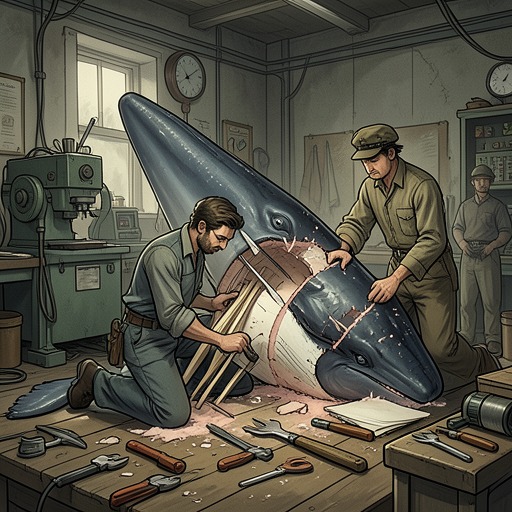
The whale’s conversion into products required specialized processes, buildings, and labor. In 1748, Jacob Rodriques Rivera introduced to New England a method for making candles from the headmatter of Sperm whale. The material went from ships to wooden manufactories, where it was heated in kettles to remove water and impurities, then stored in casks over winter until it coagulated. Workers packed it into woollen bags and pressed out the Spermaceti. The first, purest pressing was called winter-strained sperm.
The leftover material did not mark the end of the process. Stored as black cakes, it was pressed again in warmer weather to produce spring-strained oil. A third pressing left a brown residue, which was heated with wood shavings and potash until it clarified into white wax. Each stage separated another marketable substance from the same original body. The pure-burning candles made from this production became a prized product, while the sequence of pressings demonstrates how processing technology could extend the value extracted from a single whale.
The wealth produced by such operations reached well beyond the works themselves. In New England, the whale fishery helped build early industrial fortunes; in a whaling town, elaborate mansions stood as visible results of commerce conducted at sea. The exchange was stark: the materials and wealth carried from ocean to shore were secured by the death of cetaceans. Whaling also connected ships, ports, manufacturers, and consumers across long distances. The whale’s body could be rendered at one location, its products transported and sold elsewhere, and the resulting profit converted into buildings and domestic goods far from the capture.
Labor, craft, and the whale’s afterlife as an object
Not every product was made in a factory. During long voyages, crews spent much of their time idle, and whale teeth became surfaces on which sailors recorded imagined scenes and everyday experience. Teeth could reach ten inches in length; after preservation in brine and polishing with sharkskin, they were etched with needles or knives and inked with soot from the ship’s try-pots. Their images included ships, whaling, classical scenes, and designs adapted from periodicals. These objects made the whale’s body carry a record of the labor and desires of the people who hunted it.
Scrimshaw also reveals the intimacy of this material culture. Sailors handled the polished ivory, worked it with tools, and sometimes carved it into sexual or pornographic forms. Whale ivory was used for the handles of tattooing instruments, binding the animal’s remains to marks made on sailors’ bodies. At the height of the craft, in the great South Seas voyages of the 1830s and 1840s, whale bone also became delicate yarn-winding structures and pastry cutters. Once its commercial world had passed, many such pieces languished in attics before being valued anew in the late twentieth century.
John F. Kennedy’s collection gave scrimshaw another kind of public and political life. Before his presidency, he had collected thirty-four whale teeth, keeping favored examples on his Oval Office desk. In 1963, a tooth engraved with the presidential seal was ordered as a Christmas present for him. He died before receiving it; his widow placed the gift in his coffin on the night before his funeral. A carved whale tooth had moved from the material culture of whaling to a presidential collection and finally to a funerary object. Its changing meanings did not erase its origin in an industry that had turned an animal’s body into a durable possession.
Mass consumption and wartime demand
As new processes multiplied the uses of whale products, the animal entered ordinary life in forms that consumers might not recognize. Sulphurization, saponification, and distillation extended the use of whale materials in lubricants, paint, varnish, ink, detergent, leather, and food. Hydrogenation made whale oil palatable. Whale liver yielded vitamin A; whale glands supplied substances used in insulin and corticotrophin. The range extended from train fuel to automobile brake fluid, from soap and fertilizer to cosmetics and food. Whale-derived materials became part of routines whose connection to a captured whale was easy to overlook.
The same logic shaped postwar efforts to feed a hungry population. In Britain, recipes promoted Whale meat as goulash, burgers, and other familiar dishes; restaurants served whale burgers, and the meat was sold at a low price. It could be grilled, braised, or minced and served with ordinary accompaniments. The effort to make it resemble established foods helped turn an unfamiliar animal product into a practical substitute during rationing. In 1948, the factory ship Balaena returned to Southampton with a cargo that included 4,500 tons of meat, 163,000 barrels of edible oil intended for margarine, 10,000 barrels of sperm oil, 170 tons of meat extract, and a further 3,000 tons of meat for cattle fodder. The scale of that cargo made the whale’s economic role measurable in food supplies as well as industrial output.
At sea, the conversion could be still more comprehensive. On an Antarctic expedition, one Blue whale yielded 133 barrels of oil and sixty tons of meat valued at $28,000. Its blubber was reduced in steel boilers, and oil from its liver was extracted for vitamins. The killing and processing took place far from land, where wounded men might die without access to a hospital. Regulations prohibited targeting mother-and-calf pairs, yet pregnant whales were taken; one Blue whale mother endured nine harpoons and five hours before dying. The efficiency of the operation coexisted with disregard for both the animals’ lives and the vulnerability of the workers who carried it out.
Uses, costs, and public memory
The chain of use persisted in places where whaling was still a local industry. In the Azores, whale flour was valued as fertilizer because it helped crops and reduced insects; at a processing works, Whale meat was ground into flour for animal feed, liver supplied vitamin extracts, and teeth became scrimshaw. The statement that nothing was wasted described a practical achievement, but it also exposed the governing principle: every part of the animal was assigned a use, down to the material later destined for tourists’ shelves. The industrial completeness of the process did not make the killing less consequential.
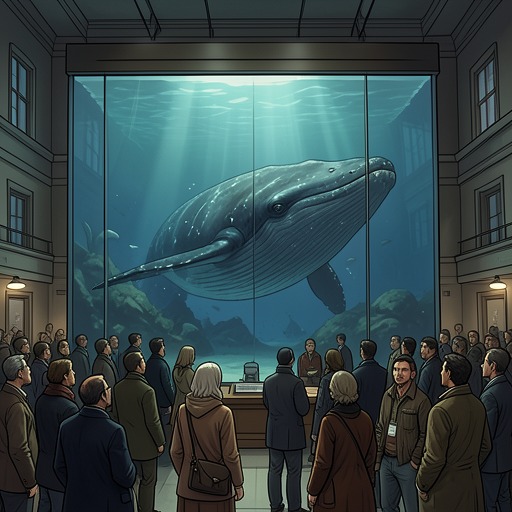
The whale’s remains could also shift from raw material to public exhibit. A fifty-ton, sixty-six-foot Blue whale that washed ashore on Rhode Island in 1998 was cut into sections and lowered into a river, where small organisms consumed its flesh over two years. Its cleaned bones were reassembled and hung in a museum atrium, visible to the public by day and night. The skeleton still dripped oil, and its smell marked the display as more than an abstract scientific object: traces of the animal’s material presence remained in the building. Where industrial processing had separated the whale into useful commodities, the museum presented its reconstructed body as a single monumental form.
That contrast frames the concept’s central tension. Whaling made wealth, light, food, craft, and industrial materials from the bodies of animals whose migrations and feeding belonged to the ocean’s own systems. The products entered domestic and national economies so thoroughly that the whale could be present in daily life while absent from view. Museums and surviving objects restore some visibility to that history, but they cannot undo its costs. The whale’s conversion into resource is therefore both a record of human ingenuity and an account of how economic usefulness can conceal the life it consumes.